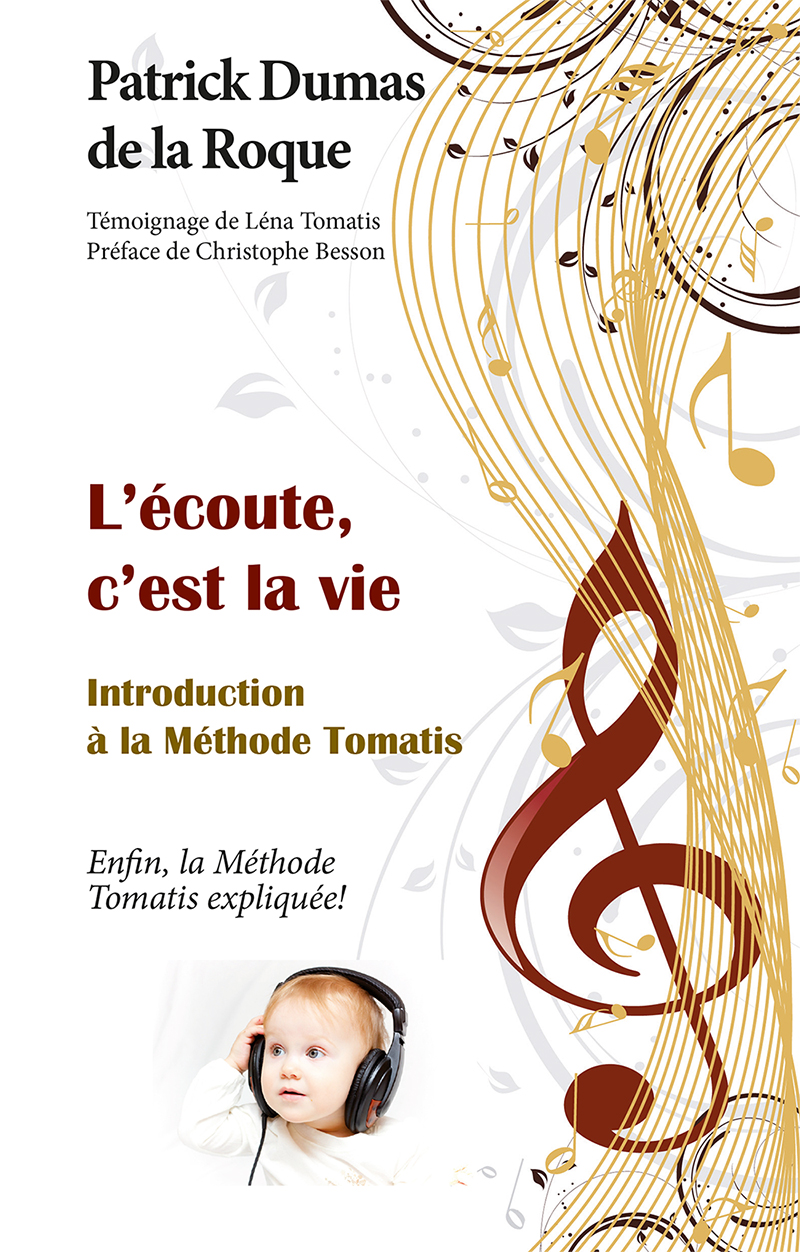
L'écoute, c'est la vie
2ᵉ édition revue, Éditions Besson, 2014
Amazon price : €19.00 — €15.00 direct from the publisher.
One hundred and fifty pages to grasp what took Tomatis a lifetime to establish: that the voice depends on the ear, that the ear depends on the psyche, and that the psyche is formed in listening. A clinical psychologist trained by Tomatis himself, Patrick Dumas de la Roque wrote the book that was missing — the one you read straight through and then lend out.
« La finalité, s’il en est une, c’est bien de savoir écouter. » (“The purpose, if there is one, is to know how to listen.”)
— Alfred Tomatis, quoted by the author
About the book
The aim is simple and ambitious: to offer an accessible synthesis of a body of work reputed to be difficult, without giving an inch on rigour. The author — settled in Toulouse after several years spent assisting Professor Tomatis in England — had both the scientific standing and the warmth of a teacher. He writes, he says, “for anyone wishing to discover what listening is, through the considerable work of Dr Alfred Tomatis”: parents, teachers, singing and language teachers, psychologists, doctors, the plainly curious.
Audio-Psycho-Phonology is presented here as the joining of three disciplines long held apart: audiology, phonology and psychology. Hearing is a passive phenomenon, something undergone; listening is an act, an intention, and it can be taught. That difference is what the whole method rests on.
Contents
The first part sets out the theory: the Tomatis laws, the great functions of the ear, the ear that recharges the brain, listening in the womb and the father’s voice, the listening test, the therapy, and why Mozart.
The second is a field guide built on case studies: the child with delayed speech, the child failing at school, the autistic child, the adopted child, the epileptic child; then, in adults, the singer and the musician (“we sing with our ears!”), language learning, pregnancy, existential depression, Ménière’s vertigo.
A testimony and a preface
This second edition, published by Éditions Besson with the support of the F.I.A.P.E., opens with two texts that make it a document in its own right.
Léna Tomatis signs the opening testimony, where she speaks of the husband she had lost thirteen years earlier with her customary restraint: “I used to say that he was always 300 m above the ground while I was struggling along down here on Earth.”
Christophe Besson signs the preface, and tells there — a rare thing — his own story: the technical school in Neuchâtel in the mid-1980s, the dyslexic and hyperactive child he had been, repairing Tomatis equipment at the Centre de l’Écoute, meeting Alfred Tomatis in 1991 (“the meeting was extraordinary, overwhelming”), and the birth, two years later, of a new generation of the Oreille Électronique Besson®.
Who it is for
The book to put into anyone’s hands as a way into the method: short, clear, alive. To be recommended to parents, teachers, practitioners in training, students of psychology or speech therapy — and to anyone who wants to understand quickly, before taking on Pierre Sollier’s treatise.
Layout and cover: Sandra Huguenin. Published with the support of the F.I.A.P.E. — Fédération Internationale d’Audio-Psycho-Phonologie et Pédagogie de l’Écoute. 1st edition: Jouvence, 2007.
Details
- Author
- Patrick Dumas de la Roque
- Publisher
- 2ᵉ édition revue, Éditions Besson, 2014
- Language of this edition
- French edition
- ISBN
- 978-2-8399-1378-2
- Pages
- 150
- Price
- €15.00 / CHF16.00